
You just finished a test and handed it to your teacher. Now you are sitting at your desk wondering, “How did I do?” You remember getting some questions wrong, but you are not sure what that means for your final score.
Here is good news: you do not need to wait for your teacher to know your grade. If you know how many questions you got wrong, you can calculate your test score in less than a minute. This guide will show you exactly how to do it using simple math that anyone can understand.

Whether you got 2 questions wrong on a 20-question quiz or 15 questions wrong on a 100-question exam, the process is always the same. Let me show you step by step.
Why Calculate from Wrong Answers Instead of Right Answers?
You might wonder, “Why not just count the right answers?” Good question! Here is why counting wrong answers is actually easier:
It is faster. When you finish a test, you usually remember the questions you were unsure about or knew you got wrong. Counting these is quicker than going through every single question.
It is less work. On a 50-question test, if you got 5 wrong, it is easier to count 5 questions than to count 45 correct ones.
Teachers grade this way too. Most teachers mark wrong answers with an X, then subtract from the total. They use the same method you will learn here.
You can do it in your head. With practice, you can quickly estimate your score right after finishing a test.
The Simple Formula You Need to Know
Here is the basic math for calculating your test score from wrong answers:
Step 1: Start with the total number of questions
Step 2: Subtract the wrong answers
Step 3: Divide by the total questions
Step 4: Multiply by 100 to get your percentage
The formula looks like this:
(Total Questions – Wrong Answers) ÷ Total Questions × 100 = Your Score
Do not worry if math formulas make you nervous. I will show you real examples that make this super easy to understand.
Example 1: A Simple 10-Question Quiz
Let’s start with something easy. Imagine you took a 10-question spelling quiz and got 2 words wrong.
Here is how to calculate your score:
Total questions: 10
Wrong answers: 2
Step 1: Subtract wrong from total
10 – 2 = 8 correct answers
Step 2: Divide correct by total
8 ÷ 10 = 0.8
Step 3: Multiply by 100
0.8 × 100 = 80%
Your score is 80%, which is a B!
See? That was not hard at all. Let’s try a bigger example.
Example 2: A 25-Question Test
Now imagine you took a 25-question history test. You think you got about 5 questions wrong.
Let’s calculate:
Total questions: 25
Wrong answers: 5
Step 1: Find correct answers
25 – 5 = 20 correct
Step 2: Divide
20 ÷ 25 = 0.8
Step 3: Convert to percentage
0.8 × 100 = 80%
Again, you got 80%! Notice something interesting? Getting 2 wrong out of 10 gives you the same percentage as getting 5 wrong out of 25. That is because both are the same fraction: you got 80% of the questions right.
Example 3: A 100-Question Final Exam
Big tests can feel scary, but the math stays simple. Let’s say you took a 100-question final exam and you are pretty sure you missed 12 questions.
Calculate your score:
Total questions: 100
Wrong answers: 12
Step 1: Subtract
100 – 12 = 88 correct
Step 2: Divide
88 ÷ 100 = 0.88
Step 3: Percentage
0.88 × 100 = 88%
You got 88%, which is a solid B+!
The great thing about 100-question tests is that the math is even easier. Each question is worth exactly 1%, so if you got 12 wrong, you lost 12%. That means your score is 100% – 12% = 88%.
What About Tricky Numbers?
Sometimes test questions are not nice round numbers like 10, 25, or 100. What if you have a 17-question quiz or a 43-question test? The process is exactly the same, but you might need a calculator.
Example: 17 questions, 3 wrong
17 – 3 = 14 correct
14 ÷ 17 = 0.823…
0.823 × 100 = 82.3%
Example: 43 questions, 8 wrong
43 – 8 = 35 correct
35 ÷ 43 = 0.813…
0.813 × 100 = 81.3%
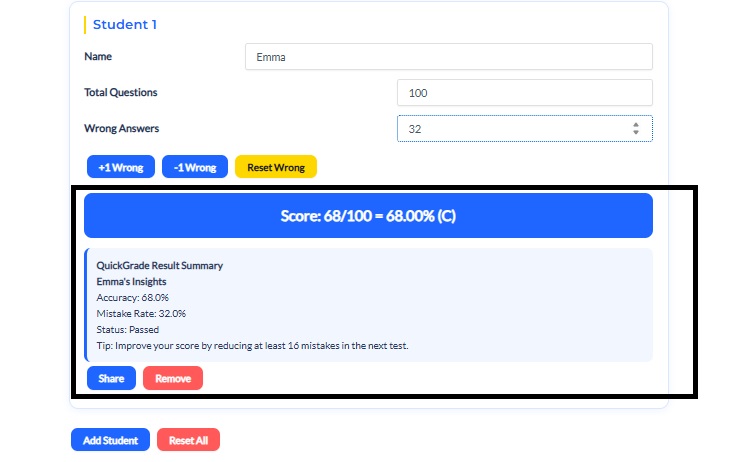
For these tricky calculations, many students use online tools to save time and avoid mistakes. The QuickGrade Calculator makes this super easy. You just type in your total questions and how many you got wrong, and it instantly shows your score. No calculator needed, no formula to remember, just quick and accurate results.
Quick Reference Chart
Here is a handy chart for common test sizes. Bookmark this page or take a screenshot!
10-Question Test
- 0 wrong = 100%
- 1 wrong = 90%
- 2 wrong = 80%
- 3 wrong = 70%
- 4 wrong = 60%
- 5 wrong = 50%
20-Question Test
- 0 wrong = 100%
- 2 wrong = 90%
- 4 wrong = 80%
- 6 wrong = 70%
- 8 wrong = 60%
25-Question Test
- 0 wrong = 100%
- 2-3 wrong = 88-92%
- 5 wrong = 80%
- 8 wrong = 68%
- 10 wrong = 60%
50-Question Test
- 0 wrong = 100%
- 5 wrong = 90%
- 10 wrong = 80%
- 15 wrong = 70%
- 20 wrong = 60%
100-Question Test
- 0 wrong = 100%
- 10 wrong = 90%
- 20 wrong = 80%
- 30 wrong = 70%
- 40 wrong = 60%
Converting Your Percentage to a Letter Grade
After you calculate your percentage, you probably want to know what letter grade that equals. Here is the most common grading scale used in schools:
- A: 90% to 100%
- B: 80% to 89%
- C: 70% to 79%
- D: 60% to 69%
- F: Below 60%
Some schools use slightly different scales, so always check with your teacher. Some might require 93% for an A, while others give an A for anything 90% or above.
Mental Math Tricks for Fast Calculations
Want to calculate your score even faster? Here are some shortcuts:
For 10-question tests: Each question is worth 10%. Just multiply wrong answers by 10 and subtract from 100.
- 3 wrong? That is 30 points off. 100 – 30 = 70%
For 20-question tests: Each question is worth 5%. Multiply wrong answers by 5 and subtract from 100.
- 4 wrong? That is 20 points off. 100 – 20 = 80%
For 100-question tests: Each question is worth 1%. Just subtract the number wrong from 100.
- 15 wrong? 100 – 15 = 85%
For 50-question tests: Each question is worth 2%. Multiply wrong answers by 2 and subtract from 100.
- 7 wrong? That is 14 points off. 100 – 14 = 86%
Common Mistakes to Avoid
When calculating test scores, watch out for these common errors:
Mistake 1: Forgetting to multiply by 100
If you stop at 0.85, that is not your percentage. You need to multiply by 100 to get 85%.
Mistake 2: Dividing wrong answers by total instead of correct answers
Always subtract the wrong answers first to find how many you got right.
Mistake 3: Using the wrong total
If your test has 30 questions but you only answered 28, should you use 30 or 28 as your total? Ask your teacher. Usually, unanswered questions count as wrong, so you would use 30.
Mistake 4: Rounding too early
Keep the decimals until the final answer, then round. Rounding too soon gives you less accurate results.
Why Knowing Your Score Matters
You might think, “Why bother calculating? My teacher will tell me eventually.” Here is why it helps:
Peace of mind. Instead of worrying about how you did, you will know right away.
Better planning. If you know you got a low score on a quiz, you can start studying harder before the next test.
Checking for errors. When your teacher returns the graded test, you can verify the score is correct. Teachers are human and sometimes make counting mistakes.
Understanding your progress. Tracking your scores over time helps you see if you are improving or need more help.
Less stress. Knowing where you stand reduces anxiety about your grades.
What If You Are Not Sure How Many You Got Wrong?
Sometimes after a test, you are not certain about your exact score. Maybe you know you definitely got 3 wrong but you are unsure about 2 more questions.
In that case, calculate both possibilities:
Best case: 3 wrong = 85%
Worst case: 5 wrong = 80%
Now you know your score will be somewhere between 80% and 85%. This gives you a realistic idea of where you stand.
Practice Problem for You
Let’s test your new skill! Try this problem:
You took a 35-question science test and you are pretty sure you got 7 questions wrong. What is your score?
Take a minute to calculate before you look at the answer below.
Answer:
Total: 35
Wrong: 7
Correct: 35 – 7 = 28
Percentage: 28 ÷ 35 = 0.8
Final score: 0.8 × 100 = 80%
Did you get it right? If yes, congratulations! You now know how to calculate test scores. If you got confused, read through the examples again and try once more.
Final Thoughts
Learning how to calculate test scores from wrong answers is a simple but powerful skill. With just basic subtraction, division, and multiplication, you can know your grade minutes after finishing any test.
Remember the basic steps:
- Subtract wrong answers from total questions
- Divide that number by total questions
- Multiply by 100 for your percentage
- Compare to the grading scale for your letter grade
Practice this skill with every test you take, and soon it will become automatic. You will walk out of the classroom knowing exactly how you did instead of wondering and worrying.
For times when you want instant results without doing the math yourself, online calculators make the process even easier. They are especially helpful for tests with tricky question totals or when you are checking your work to make sure you calculated correctly.
Now you have the knowledge to never be in the dark about your test scores again. Good luck on your next test!